Showing posts with label brothels. Show all posts

Wednesday, September 10, 2014

Officers and Gentlemen


When patriotic young men flocked to join up during the Great War, those from the upper classes were deemed to have the leadership qualities required to be officers. Not only did officers have higher pay and more privileges - including a “batman”, a military servant, to look after them and their equipment - but they also enjoyed officers-only restaurants, bars, and brothels in the British sector of the Western Front.

But officers also had greater responsibilities, and were killed in larger proportions than their men. Carrying only pistols, not bayonetted rifles, junior officers lead their troops “over the top”, and were easy for the enemy to spot and target.

Too many of the Empire’s bright young men, destined for greatness, were slaughtered.  Wilfred Owen, considered the leading war poet of his generation, was killed exactly one week before the Armistice in November 1918.
Lady Diana Manners, 1916
 Lady Diana Manners lost most of her male cohort, including Raymond Asquith, son of the Prime Minister, and married the only survivor in her circle of intellectual friends known at The Coterie. Her entertaining memoir, The Rainbow Comes and Goes, describes her privileged aristocratic life and friends, as well as her wartime work as a VAD (volunteer) nurse.

Vera Brittain’s more intense memoir, Testament of Youth, poignantly describes the loss of her fiancé, brother, and two close male friends - virtually her entire social sphere.  Vera was also a VAD, and a movie about her is soon to be released. Here’s a link to the trailer.

On the lighter side, at least one officer had weekly hampers of goodies delivered to him in France from the famous Fortnum & Mason in London. Apparently they also supplied some Prisoners of War in Germany. Such are the vagaries of war.

My Muskoka Novels immerse readers in the lives, loves, adventures, and tragedies of the “lost generation”.


Wednesday, July 16, 2014

Sex and the Soldier


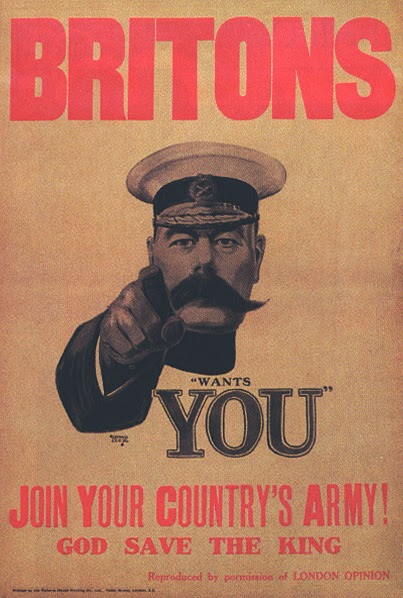
Lord Kitchener recruiting poster

Lord Kitchener wanted men to enlist, but he also advised them, "In this new experience you may find temptations both in wine and women. You must entirely resist both temptations, and, while treating all women with perfect courtesy, you should avoid any intimacy.”

But as Robert Graves wrote in his classic memoir, Goodbye to All That, "There were no restraints in France; these boys had money to spend and knew that they stood a good chance of being killed within a few weeks anyhow. They did not want to die virgins.”

Talbot Papineau
Canada and Britain’s top Ace, Billy Bishop, disclosed his affair with a French girl to his fiancé before their marriage in 1917. In Tapestry of War, Sandra Gywn explores Major Talbot Papineau’s correspondence with a close female friend. “In a manner that for the time was uncommonly frank, he’d confessed much about his sexual transgressions in London.” Papineau was killed at Passchendaele in 1917.

What is surprising is that the military sanctioned visits to licenced brothels, as sex was considered a physical necessity for the men. The "maisons de tolérance" with blue lamps were for officers, and red lamps, for the other ranks. However, no sex education or prophylactics were provided. An astonishing 400,000 cases of venereal disease (VD) were treated during the war, according to the BBC.

The rate of VD among the Canadian troops was almost 6 times higher than that of the British, and was 1 in every 9 men. Not only were the Canadians far from the influence and advantages of home, but their pay was also 5 times that of their British counterparts, so they had ample funds to buy sex and wine.

Troops who ended up in specialized VD hospitals were docked their pay, while officers had to pay 2 shilling and 6 pence for every day they spent in a VD hospital, and also lost their field allowance. Soldiers with VD were not eligible for leave for 12 months. But contracting VD was also a way to escape the horrors of the trenches, at least for a while.

My first two Muskoka Novels, The Summer Before the Storm and Elusive Dawn, explore the theme of wartime morality.